
Hydrostatic Testing
Hydrostatic Testing
Reliable Hydrostatic Testing for Pipes, Fittings and Vessels
Hydrostatic testing is used to evaluate whether a pipe, fitting, vessel, or other pressure-containing component can hold a specified pressure without leaking. At Welding & Joining Management Group® (WJMG), we provide high-pressure testing for welded components and pressure systems at our Frederick, Colorado facility.
Our hydrostatic equipment can test pipes, fittings, and vessels at pressures up to 33,600 psi, with accurate test data recorded throughout the process.
What Is Hydrostatic Testing?
If you are asking what is hydrostatic testing, it is a pressure-testing method that uses a liquid, typically water, to evaluate the integrity of a sealed component.
The component is filled with the test liquid, air is removed as required, and pressure is gradually increased to the level specified by the applicable procedure, code, or engineering requirement. Pressure is then maintained for the required period while the component is monitored for leakage or other indications of a problem.
Because liquids are far less compressible than gases, hydrostatic methods are commonly used when pressure testing piping systems and pressure-containing equipment.
What Is a Hydrostatic Test Used For?
A hydrostatic test can help determine whether a component can maintain a required pressure and whether welded joints, flange connections, fittings, or other areas are leaking.
WJMG can perform testing on:
- Pipes and piping components
- Fittings
- Pressure vessels
- Welded joints
- Flanged connections
- Other suitable pressure-containing components
Testing may be required following fabrication, welding, repairs, or as part of a project-specific quality program.
PHMSA also identifies hydrostatic pressure testing as one method used to assess pipeline integrity and verify that a pipeline has adequate strength to prevent leakage or rupture under operating conditions.
How Does a Hydrostatic Test Work?
The exact procedure depends on the component and governing requirements, but a typical hydrostatic test follows several basic steps:
- The component is prepared and sealed for testing.
- It is filled with the specified liquid.
- Air is removed from the test section as required.
- Pressure is gradually increased to the specified test pressure.
- The pressure is held for the required period.
- Pressure readings and the component are monitored for leakage or unexpected changes.
- The system is depressurized in a controlled manner after testing.
Test pressure and hold time should always be established by the applicable code, specification, engineering requirements, or approved test procedure rather than by a universal pressure multiplier.
High-Pressure Hydrostatic Testing at WJMG
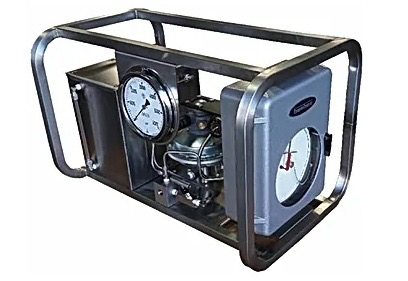
WJMG operates two hydrostatic testing units: the Barbee P300VR Hydrostatic Tester and the Barbee P200VR High Pressure Pump.
This equipment allows us to perform testing on suitable pipes, fittings, and vessels at pressures up to 33,600 psi.
Our system also provides accurate, minute-by-minute test data. WJMG validates its chart-recording equipment annually to help maintain reliable pressure readings for testing projects.
That documentation can be especially valuable when clients need a clear record of how pressure was applied and maintained during the test.
Hydrostatic Testing and ASTM E1003
When applicable, WJMG follows ASTM E1003, Standard Practice for Hydrostatic Leak Testing.
ASTM E1003 covers leak testing by internally pressurizing a component with liquid. The practice applies to piping, valves, containers, and components containing welded or fitted sections that can be sealed and are designed for internal pressure.
Testing may also need to meet additional ASME, API, project, or engineering requirements depending on the equipment and application.
For example, ASME Section VIII includes testing requirements for pressure vessels, while pipeline projects may have separate regulatory or specification requirements.
Providing the applicable code, specification, required pressure, and hold time when requesting testing helps WJMG prepare the correct procedure for the project.
Why Choose WJMG for Hydrostatic Testing?
WJMG combines high-pressure equipment with broader experience in welding, metallurgy, mechanical testing, and code compliance.
Our capabilities include:
- Testing pressures up to 33,600 psi
- Pipes, fittings, vessels, and welded components
- Minute-by-minute test data
- Annually validated chart-recording equipment
- ASTM E1003 testing when applicable
- Additional mechanical and metallurgical testing when required
This allows clients to coordinate a hydrostatic test with other laboratory services if a project requires additional weld or material evaluation.
Hydrostatic Testing FAQs
What is a hydrostatic test?
A hydrostatic test uses pressurized liquid to evaluate whether a component can maintain a specified pressure without unacceptable leakage.
What is hydrostatic testing used to detect?
Hydrostatic testing can help identify leaks and evaluate the pressure-containing integrity of suitable piping, fittings, vessels, welded joints, and related components.
Does WJMG provide recorded test data?
Yes. WJMG’s hydrostatic equipment provides minute-by-minute test data, and its chart-recording equipment is validated annually.
Schedule a Hydrostatic Test With WJMG
If your project requires testing for a pipe, fitting, vessel, welded assembly, or other pressure-containing component, WJMG can help determine the appropriate testing setup.
Testing for hydrostatic specification codes such as ASME Section IX, Section VIII, API 1104. WJMG follows the guideline in welding code but also in the guidelines written in ASTM E1003 hydrostatic leak testing. Chart record is validated each year to insure accurate readings for each job.
Contact Welding & Joining Management Group® to discuss your required test pressure, applicable specification, component dimensions, and documentation requirements.