
Bend Test
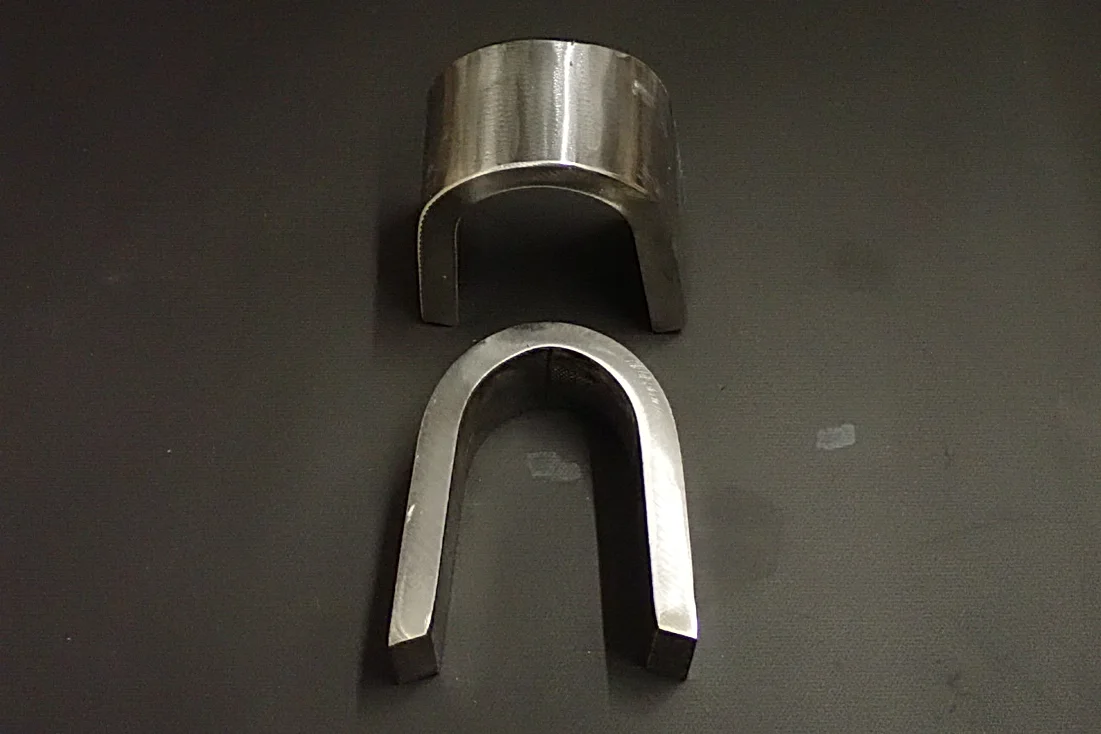

Bend Test
Proven Bend Test Services for Weld and Material Evaluation
A bend test is a practical way to evaluate how a metal or welded specimen responds when it is forced to deform. At Welding & Joining Management Group® (WJMG), we provide bend testing for material evaluation, welding procedure qualification, and welder certification. Our Frederick, Colorado laboratory supports ASTM E290 requirements as well as guided testing performed to applicable AWS, API, and ASME welding codes.
Whether you need to evaluate a weld coupon, confirm ductility, support a qualification, or investigate how a material responds under deformation, WJMG provides testing backed by more than 50 years of experience in welding, metallurgy, mechanical testing, and code compliance.
What Is a Bend Test?
A bend test evaluates the ductility and soundness of a metallic or welded specimen by bending it to a specified angle or around a specified radius. After the specimen is bent, the exposed surface is examined for cracks, fractures, openings, or other relevant indications.
Unlike tensile testing, which pulls a specimen to measure properties such as yield strength and ultimate tensile strength, this method focuses on how a material or weld behaves during plastic deformation. It can help reveal discontinuities and determine whether a specimen meets the acceptance requirements of the applicable code, specification, or test plan.

What Does Bend Testing Evaluate?
Bend testing can provide valuable information about how a material or weld responds to deformation. Depending on the project requirements, it may be used to evaluate:
- Ductility of metallic materials
- Weld soundness
- Cracking or fracture after deformation
- Surface-breaking discontinuities revealed during bending
- Welder performance qualification
- Welding procedure qualification
- Compliance with applicable testing requirements
The required specimen dimensions, bend radius, test orientation, and acceptance criteria depend on the governing standard or welding code. WJMG reviews those requirements before testing so the specimen can be prepared and evaluated using the appropriate method.
Guided Testing for Weld Qualification
Guided bend testing is commonly used during welder performance qualification and welding procedure qualification. WJMG has the equipment and experience needed to support qualification work under applicable AWS, API, and ASME requirements.
Depending on the qualification, the required specimens may include face, root, or side bends.
- Face Bend
- Root Bend
- Side Bend


Bend Testing to ASTM E290
WJMG performs bend testing in accordance with ASTM E290 when that standard applies to the project. ASTM E290 addresses testing of metallic materials for ductility and establishes requirements related to specimen bending and examination.
During the procedure, a prepared specimen is positioned in the proper fixture and bent using the required geometry. The specimen is taken to the specified angle or condition required by the applicable procedure or standard. After bending, the surface is visually examined for cracks, fractures, or other irregularities that may affect the result.
When the test is being used for acceptance or qualification, the governing code or specification determines the allowable indications and pass/fail criteria.
When Is a Bend Test Needed?
A bend test may be requested for several reasons, including welder certification, procedure qualification, material ductility evaluation, weld procedure development, quality control, or compliance with an ASTM, AWS, API, ASME, or project-specific requirement.
It can also be one part of a broader mechanical or metallurgical evaluation. If the project requires additional information, WJMG can combine the results with tensile testing, hardness testing, Charpy impact testing, macro-etch examination, fillet weld break testing, or other laboratory services.
If you are unsure which method is required, our team can review the project requirements and help identify the appropriate approach.

How Does the Testing Process Work?
Although the exact procedure depends on the governing requirement, the process generally begins with specimen preparation. The specimen is machined or prepared to the required dimensions, positioned in the appropriate fixture, and bent around or against the specified die, mandrel, or plunger.
After the specimen has been bent, it is examined according to the applicable acceptance criteria. For qualification work, the code determines the number and type of specimens, the required bend geometry, and what indications are acceptable.
This is why the process involves more than simply bending a piece of metal. Accurate specimen preparation, correct fixture geometry, and proper interpretation of the governing requirements are all important to obtaining a meaningful result.
Why Choose WJMG?
WJMG approaches every bend test within the larger context of welding quality, metallurgy, and code compliance. That broader perspective is especially valuable when the work is being performed for welder certification or procedure qualification, where the result is only one part of a larger set of requirements.
Our mechanical testing capabilities include tensile testing, hardness testing, Charpy impact testing, fillet weld break testing, macro-etch examination, and additional material evaluation services. WJMG also provides welder certification, welding consultation, nondestructive testing, microscopy, and forensic metals services.
For contractors, fabricators, inspectors, engineers, and other industry professionals, this means testing can be coordinated with the additional technical services a project may require.
Bend Test FAQs
What is the purpose of a bend test?
The purpose of a bend test is to evaluate how a metallic material or welded specimen responds to deformation. It can help assess ductility, expose certain discontinuities, and support qualification or acceptance requirements.
What is the difference between face, root, and side bends?
The difference is the orientation of the specimen. A face bend places the weld face on the convex side, a root bend places the weld root on the convex side, and a side bend exposes the weld cross-section during deformation.
Does WJMG perform testing for welder qualification?
Yes. WJMG performs guided testing to support welder certification and qualification under applicable AWS, API, and ASME welding codes.
Does WJMG perform ASTM E290 bend testing?
Yes. WJMG performs bend testing in accordance with ASTM E290 when it is the applicable standard for the project.
Schedule Testing With WJMG
If your project requires a bend test for material evaluation, welder certification, welding procedure qualification, or code compliance, WJMG can help. Our team combines mechanical testing capabilities with practical welding and metallurgical expertise to support accurate, code-conscious evaluation.
Contact Welding & Joining Management Group® to discuss your testing requirements and determine the right approach for your project.