
Tensile Testing

Tensile Testing
Proven Material Tensile Testing for Metals and Welds
Material tensile testing provides measurable information about how a metal or welded specimen responds when pulled under a controlled load. At Welding & Joining Management Group® (WJMG), we perform tensile testing for material verification, weld evaluation, procedure qualification, and other mechanical testing requirements at our Frederick, Colorado laboratory.
Our tensile and compression equipment ranges from 10 lbf to 200,000 lbf, allowing WJMG to evaluate specimens and components across a wide range of testing requirements.
What Is a Tensile Test?
The specimen is secured in a testing machine and gradually loaded in tension. As the material stretches, the equipment records how it responds until the required endpoint or failure is reached.
A tensile test can provide valuable information about the strength and ductility of a metallic material, including:
- Yield strength
- Ultimate tensile strength
- Elongation
- Stress and strain
- Reduction of area, when required
These measurements help engineers, fabricators, inspectors, and manufacturers compare materials or determine whether a specimen meets an applicable specification.
How Material Tensile Testing Works
Accurate testing begins with proper specimen preparation.
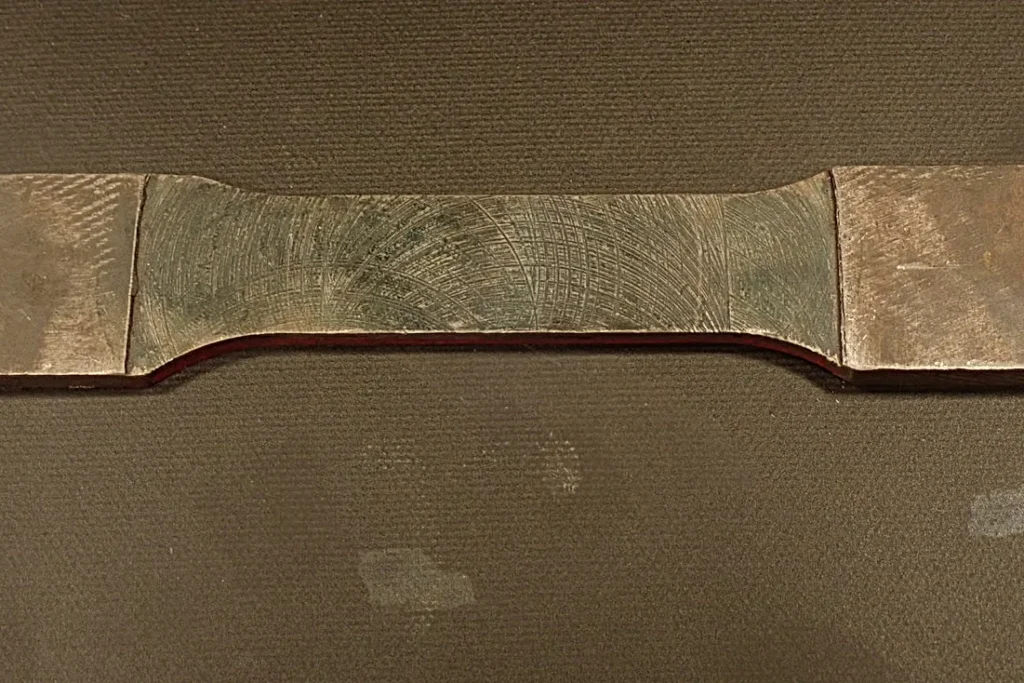
Depending on the material and specification, WJMG can produce reduced-section tensile specimens and round tensile bars. The dimensions and orientation of the sample are determined by the applicable testing standard, welding code, or project requirements.
During the test, an axial load is applied to the specimen while force and deformation are recorded. This information can be used to determine engineering stress and strain and, when required, calculate true stress and strain after testing.
Because specimen geometry affects the results, preparation should follow the applicable requirements rather than using the same specimen configuration for every project.
What Does a Tensile Test Tell You?
This test provides several useful measurements from a single controlled test.
Yield strength identifies the stress at which a material begins to deform permanently. Ultimate tensile strength represents the maximum tensile stress the specimen withstands during testing. Elongation shows how much the specimen stretches and provides information about material ductility.
Together, these values can help determine whether a material performs as expected and whether its measured properties meet the applicable requirement.
This makes testing useful for material verification, quality control, welding procedure qualification, and comparison of metallic materials.

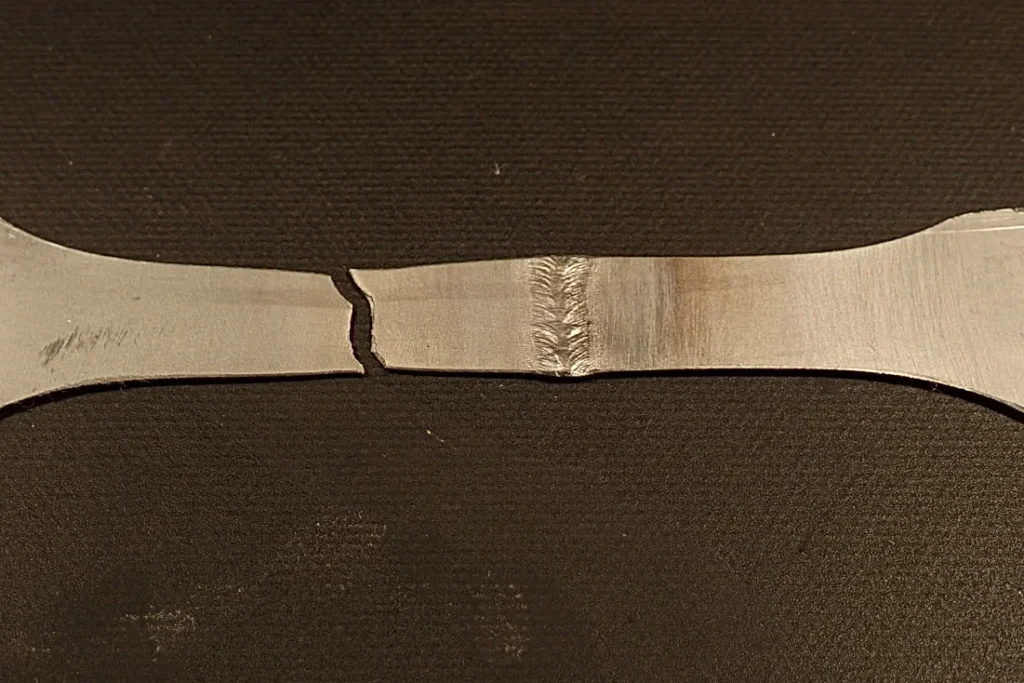
Tensile Testing for Weld Qualification
WJMG also performs tensile testing for welded specimens and procedure qualification records, commonly called PQRs.
For qualification work, the required specimen dimensions, preparation, testing procedure, and acceptance criteria depend on the governing welding code.
WJMG can prepare appropriate tensile specimens for applicable AWS, ASME, and API qualification requirements. Combining specimen preparation and testing within the same laboratory helps keep the process coordinated from the original sample through the final test data.


ASTM Standards for Material Tensile Testing
One of the primary standards for metallic tensile testing is ASTM E8/E8M, Standard Test Methods for Tension Testing of Metallic Materials. The standard addresses determination of properties including yield strength, tensile strength, elongation, and reduction of area.
WJMG may also perform testing to other applicable requirements, including ASTM A370 for mechanical testing of steel products and ASTM B557 for tension testing of wrought and cast aluminum- and magnesium-alloy products.
The correct standard depends on the material and project specification, so clients should provide applicable drawings, codes, material requirements, or testing instructions when requesting a test.
Why Choose WJMG for Tensile Testing?
WJMG combines material tensile testing with practical experience in welding, metallurgy, and mechanical testing.
Our capabilities include:
- Testing capacities from 10 lbf to 200,000 lbf
- Reduced-section and round specimen preparation
- Yield strength, ultimate strength, and elongation measurement
- Weld and PQR testing
- ASTM, AWS, ASME, and API testing support
- Related hardness, bend, Charpy impact, chemical, and metallurgical testing
This allows clients to coordinate a tensile test with additional material evaluation when a project requires more than tensile properties alone.
Schedule Material Tensile Testing With WJMG
Whether you need a tensile test for material verification, weld qualification, or another mechanical testing requirement, WJMG can help determine the appropriate specimen and testing procedure.
WJMG follows the guidelines from ASTM E-3 standards test methods for tension testing of metallic materials, along with other ASTM standers such as A-370, B-557, F-60. WJMG can produce the correct sample for AWS, ASME, and API welding codes for procedure qualification records.
Contact Welding & Joining Management Group® to discuss your tensile testing requirements, applicable standard, specimen preparation, and project specifications.