
What Is the ARL 3460? How WJMG Uses OES for Metal Analysis

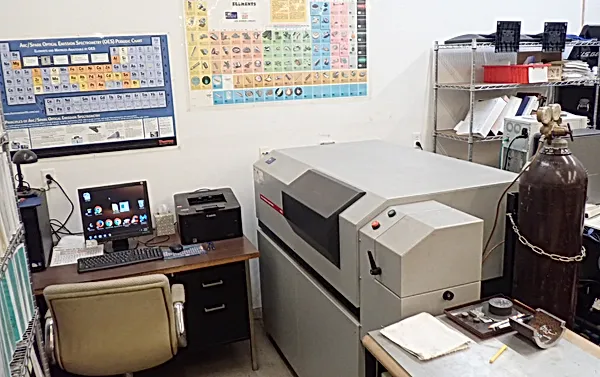
When the exact composition of a metal matters, appearance alone cannot provide the answer. At WJMG, the ARL 3460 Optical Emission Spectrometer (OES) is one of the tools used for chemical analysis of base metals, weld metals, and a range of alloys. By identifying the elemental composition of a sample, the instrument can provide valuable information for material verification, welding evaluation, quality control, and broader metals testing.
What Is the ARL 3460?
The ARL 3460 is an optical emission spectrometer developed specifically for metals analysis. Thermo Fisher describes the instrument as a multi-channel OES system designed for fast and accurate analysis of metallic materials. The model has been used in environments ranging from metal production and foundries to incoming-material inspection, quality control, and research laboratories.
At WJMG, the instrument is part of the company’s chemical analysis capabilities, giving technicians another way to determine what a metal sample is actually made of rather than relying solely on markings, documentation, or visual characteristics.
How Does Optical Emission Spectroscopy Work?
Optical emission spectroscopy identifies elements based on the light produced when atoms in a metal sample are energized.
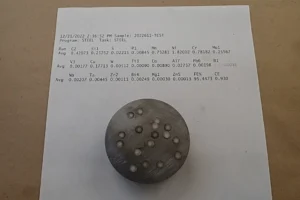
In simple terms, the process works like this:
- The metal sample is excited using an electrical discharge.
- Elements within the sample emit light at characteristic wavelengths.
- The spectrometer separates and measures that light.
- The resulting spectral information is analyzed to determine elemental composition.
Different elements produce distinctive spectral signals, allowing an OES instrument to identify and quantify components within a metal sample. Thermo Fisher describes OES as a method in which a sample is excited and the resulting emitted-light spectrum is used to determine the components of solid metals.
This makes the ARL 3460 useful when the question is not simply, “Is this metal?” but rather, “What is this metal composed of?”
What Materials Can WJMG Analyze With the ARL 3460?
WJMG uses its ARL 3460 Optical Emission Spectrometer to detect elemental composition in both base metal and weld metal. Its listed applications include materials such as:
- Carbon steel
- Stainless steel
- Aluminum
- Copper
- Hastelloy
- Other metal alloys
The specific analytical information available depends on the material, sample condition, instrument configuration, and testing requirements.
That versatility is especially useful in welding and metallurgy because two materials can look similar while having very different chemical compositions and performance characteristics.
How Does WJMG Prepare Small Samples for Analysis?
Not every client has a large, convenient piece of metal available for testing. Sometimes the material arrives as drill cuttings, filings, metal shavings, wire, or another small sample.
WJMG can melt smaller material using an electric arc furnace to create a specimen suitable for rapid alloy analysis. This allows the laboratory to obtain useful chemical information even when a conventional test specimen is not initially available.
This sample-preparation capability expands the situations in which laboratory chemical analysis may be practical.
Why Is Chemical Composition Important in Welding and Metal Testing?
Knowing the chemical makeup of a material can help answer important questions during fabrication, inspection, or investigation.
For example, analysis may help professionals determine whether the correct alloy was used, evaluate base metal or weld metal, investigate a suspected material mix-up, or provide additional information when reviewing a failed component.
Chemical composition can also complement other forms of testing. WJMG offers mechanical testing, microscopy, nondestructive testing, hardness testing, tensile testing, and other metallurgical services, allowing material chemistry to be considered alongside physical and mechanical properties when appropriate.
Is the ARL 3460 the Same as a Handheld Alloy Analyzer?
Not exactly.
WJMG also uses a Niton XLT analyzer that can determine material composition without requiring a sample to be removed from the component. The ARL 3460, by comparison, is a laboratory optical emission spectroscopy system used for elemental analysis of prepared metal samples.
WJMG also lists Energy Dispersive X-Ray analysis for examining small regions of interest, including areas associated with fractured components. Different tools can therefore be selected depending on the material, sample size, location, and question the testing needs to answer.
Turning Metal Composition Into Useful Information
The value of the ARL 3460 is not simply that it produces chemical data. That data can become another piece of evidence for understanding a material, weld, component, or failure.
At WJMG, optical emission spectroscopy fits into a larger approach to metals and welding analysis. Whether the goal is verifying an alloy, evaluating weld and base metal composition, supporting material testing, or investigating an unexpected condition, understanding what the metal is made of to help professionals make decisions based on measurable information rather than assumptions.